
Replacing a 50 Gallon Water Heater With a Tankless System
If you’re considering replacing your 50-gallon water heater with a tankless model, you’ll want to weigh the benefits carefully. Tankless water heaters are known for their energy efficiency and space-saving design, but there’s more to the story. Imagine never running out of hot water, even during peak usage times, and enjoying lower utility bills thanks to advanced technology. Plus, with a lifespan that can last 15-20 years, these systems promise long-term reliability. But are they the perfect fit for every household? Let’s explore whether a tankless water heater is the right upgrade for you.
Replacement Sizes Based on Family Size and Usage
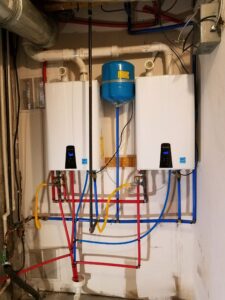 When replacing a water heater, selecting the right size is essential for guaranteeing efficiency and meeting your household‘s needs. You need to calculate your peak hour demand. First, consider the number of people in your household. Typically, a family of four requires a water heater capable of handling 34-50 gallons during peak usage hours.
Next, evaluate your usage patterns. For example, if your household takes multiple showers, runs the dishwasher, and does laundry simultaneously, you’ll need a higher capacity. On the other hand, if usage is staggered, a smaller unit might suffice.
Tankless water heaters are rated by their flow rate, measured in gallons per minute (GPM). To determine the required GPM, add up the flow rates of all fixtures and appliances you expect to use concurrently. For instance, a showerhead typically uses 2.5 GPM, a dishwasher 2-4 GPM, and a washing machine 3-5 GPM. If all are used at once, you’ll need a tankless unit that can handle at least 7.5 GPM. A 50-gallon water heater should be replaced with a tankless system with a 10 GPM flow rate just to be safe.
Selecting the right flow rate ensures you won’t experience cold showers or excessive energy costs. Proper sizing optimizes performance, providing hot water on demand without unnecessary waste.
| Traditional Water Heater Size | Household Size (Number of People) | Tankless Water Heater (GPM) | Usage (Approximate) |
|---|---|---|---|
| 30 gallons | 1-2 | 4-6 GPM | Small apartment, single bathroom |
| 40 gallons | 2-3 | 7-8 GPM | Small home, one bathroom, moderate demand |
| 50 gallons | 3-4 | 9-10 GPM | Medium home, 2 bathrooms, higher demand |
| 66 gallons | 4-5 | 10-11 GPM | Larger home, 2-3 bathrooms |
| 80 gallons | 5+ | 11+ GPM | Large home, 3-4 bathrooms, multiple high-demand fixtures |
Benefits of Replacing Your 50-gallon Tank
Upgrading your 50-gallon tank can greatly boost energy efficiency, cutting down your utility bills. The latest models also offer space-saving designs, freeing up valuable square footage in your utility room. Additionally, the enhanced longevity of modern units guarantees you’ll encounter fewer repairs and replacements over time.
Energy Efficiency
Upgrading your 50-gallon water heater to a more energy-efficient model can greatly lower your utility bills through reduced energy consumption. Modern water heaters use advanced insulation and heat pump technology to minimize heat loss, maximizing energy savings. Additionally, newer models often have a more compact design, freeing up valuable space in your utility room.
Space-Saving Design
A considerable advantage of moving away from a bulky 50-gallon water heater is the space-saving design of modern alternatives. Tankless water heaters, unlike traditional tank-based systems, are compact units that can be wall-mounted. You’ll free up valuable floor space in your utility area, making room for other essential appliances or storage needs.
To install a tankless unit, follow these steps. First, choose an appropriate location, typically near existing water and gas lines, to minimize additional plumbing work. Next, mount the unit securely on the wall using manufacturer-provided brackets. Verify proper ventilation if the model is gas-powered; improper venting can lead to combustion issues.
After mounting, connect the cold and hot water lines, guaranteeing all connections are leak-free. Use dielectric unions to prevent corrosion between dissimilar metals. If your unit is gas-powered, connect the gas supply using a flexible gas line, checking for leaks with a soapy water solution.
Tankless water heaters often have digital control panels, allowing precise temperature adjustments. You’ll benefit from on-demand hot water without the need for a large storage tank, greatly optimizing your space and efficiency. The streamlined design also provides easier access for maintenance and repairs.
Longevity
One of the key benefits of shifting to a tankless water heater is its impressive longevity. Traditional 50-gallon water heaters typically last around 10-15 years. In contrast, tankless units often boast a lifespan of 15-20 years, thanks to their advanced design and fewer components susceptible to wear and tear.
First, tankless water heaters operate on demand, meaning they only activate when you need hot water. This reduces the constant strain on the system, minimizing the likelihood of corrosion and sediment buildup that commonly plagues tank-based models. Consequently, you won’t face frequent maintenance issues, saving both time and money.
Second, many tankless models feature replaceable parts, such as the heating elements and sensors. This modular design allows you to perform targeted repairs rather than replacing the entire unit, extending its operational life even further.
Third, the absence of a storage tank eliminates the risk of tank ruptures, a catastrophic failure often seen in aging 50-gallon systems. By reducing potential points of failure, tankless heaters offer a more reliable, long-term solution.
Conclusion
By replacing your 50-gallon water heater with a tankless model, you’ll gain enhanced energy efficiency, save space, and enjoy a reliable, long-term solution. You’ll experience hot water on demand, lower utility bills, and a system that outlasts traditional tanks. With 15-20 years of lifespan and easy, targeted repairs, tankless water heaters are a smart investment for any home. Don’t wait—contact Plumbing Solutions today to upgrade and optimize your home’s performance and space.
Welcome to Plumbing Solutions of Nashville, TN

#1 Nashville Plumber
We Specialize in All Your Plumbing Needs

24/7 Emergency Service
If you are experiencing a plumbing emergency, or if you are just looking for a 24 hour plumbing service, give us a call!
Plumbing Solutions
Plumbing Solutions is a full-service Nashville plumbing company for residential and commercial plumbing.
Service Areas
Contact local plumbers near you! Plumbing Solutions proudly services Middle Tennessee.
Plumbing Costs
Plumbing costs vary by job. Plumbing Solutions offers no-cost parts and labor estimates BEFORE work starts.